One Clean Email Over Multiple News Apps
You don't need five apps to stay informed. You need one email that tells you what actually happened, and then lets you get on with your day.
Posted by
 Matjaz Gazvoda
Related reading
The Reason You Feel Informed but Can't Actually Think
There's a specific kind of tiredness that comes after an hour of scrolling. You consumed a lot. You absorbed almost none of it. Here's why, and what to do instead.
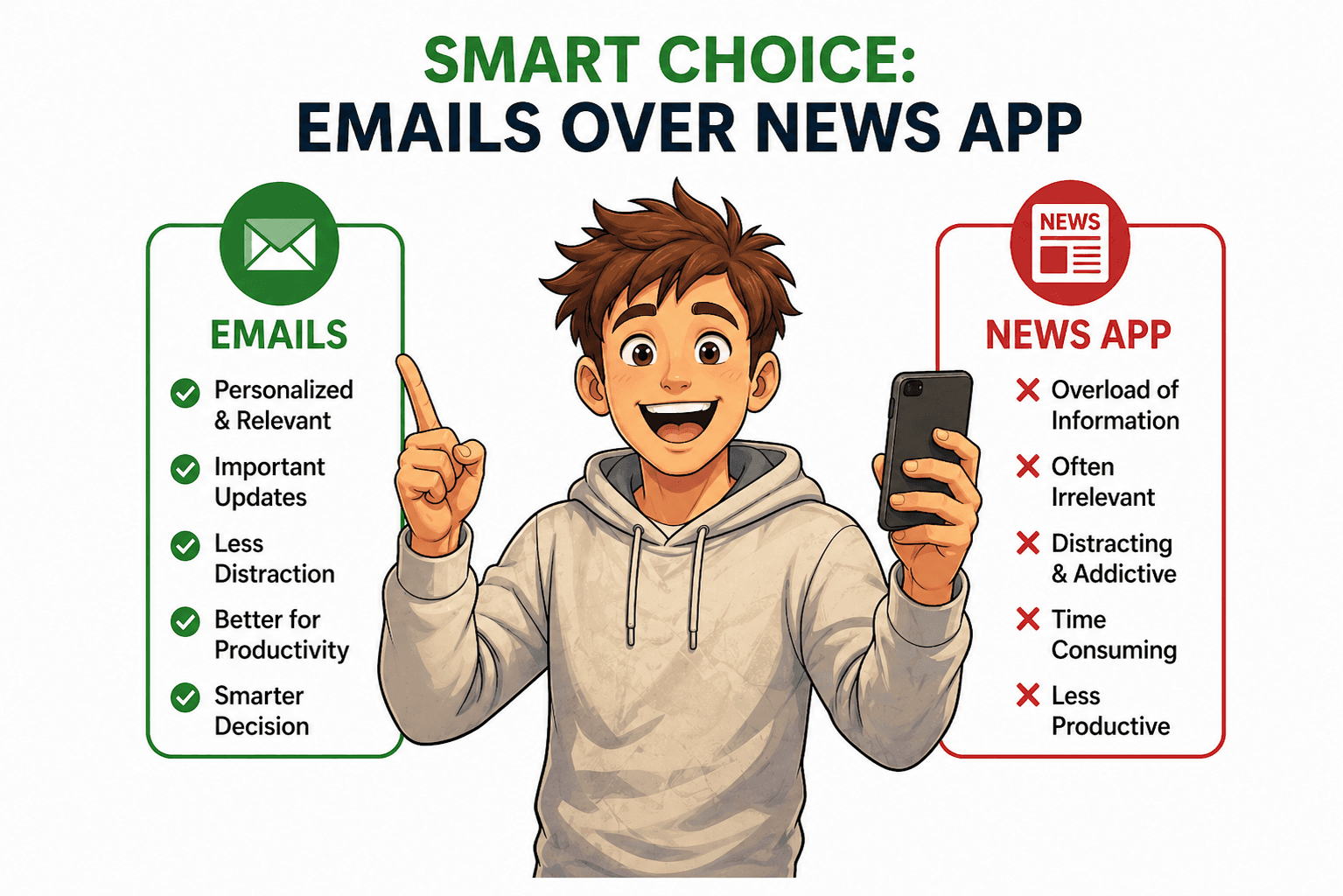
The morning routine goes something like this. You open Twitter to check what's trending in tech. Then Reddit to see what the community is saying. Then Hacker News for anything deeper. Then a news app for the broader picture. Then back to Twitter because something looked interesting on the way through. Forty minutes later you close your phone, vaguely aware that something important happened somewhere, and sit down to work with your head already full of noise.
This is the hidden cost of the multi-app information diet: not the time you spent, but the mental state you arrive at on the other side.
Every App Is Designed to Keep You Inside It
The problem isn't that these apps have bad content. Most of them have great content. The problem is the environment that content lives in. Every feed, every timeline, every trending section was engineered by people whose job was to maximize the time you spend in that app, not the value you extract from it. These are different goals, and the design reflects that.
The moment you finish the article you came for, something new appears below it. A reply that's slightly provocative. A thread you almost recognize. A post that touches something you were already thinking about. None of it is an accident. The algorithm has a model of you, and it knows exactly which lever to pull to get another thirty seconds. Then another. Then another.
You went in looking for signal. You came out with signal plus an hour of noise you never asked for, and a restlessness that makes it harder to focus on anything that follows.
An Email Has No Algorithm Trying to Trap You
This is what makes email a fundamentally different medium, not better in every dimension, but better in the dimension that matters most for staying informed: it ends. There is no recommendation engine deciding what to surface after you finish reading. There is no autoplay, no related content, no trending sidebar designed to redirect your attention the moment it starts to wander. You read what's there, and then it's done.
A well-composed digest gives you a complete picture of your world in one place. What happened in your industry. What the community is discussing. What the broader news cycle looks like. Everything you actually track, assembled, filtered, and delivered in a format where you control when it starts and when it stops. Not the app.
That shift in control is more significant than it sounds. When you choose to close the email, you leave. When you're using a feed, leaving requires willpower, because the feed was designed to resist it. The asymmetry matters at 7am when your willpower is still loading.
The Overview Effect, But for Information
There's a concept in space travel called the overview effect: astronauts who see the Earth from orbit often describe a sudden clarity about what matters and what doesn't, because the perspective changed. A digest does something structurally similar with your information diet. Instead of being inside each story as it develops, reacting to it in real time, you get a view from slightly above. Here is what happened. Here is what the conversation looks like. Here is what you need to know.
That overview is genuinely hard to get when you're living inside five different apps simultaneously. Each one presents itself as the whole picture. Twitter shows you what Twitter thinks is important. Reddit shows you what Reddit upvoted. Hacker News shows you what its community found interesting this morning. None of them know what you actually need to track, and none of them are trying to figure that out. They're trying to show you more of what keeps you engaged.
A digest built around your actual interests, your subreddits, your sources, your topics, gives you the overview without the immersion. You get the map, not the maze.
One Place, One Read, Done
The practical case is simple. If you could read one thing in the morning that covered everything you actually care about, and if that thing ended when you finished reading it rather than generating more of itself indefinitely, you would spend less time, retain more, and start your working hours in a cleaner mental state. That's not a hypothesis. It's the experience of everyone who has made the switch.
Read What Matters is built around this idea. You pick your sources, set your schedule, and each morning a single email lands with exactly the content you chose, nothing else attached. No algorithm nudging you toward the next thing. No notification pulling you back in an hour later. Just the information you wanted, in a format that respects the fact that you have other things to do with your day.
You were looking for an edge. The edge isn't more apps. It's fewer, with one email that does the work of all of them.
